Goal Framework vs SMART Goals vs OKRs
Three useful systems, three different jobs.
SMART goals, OKRs, and goal frameworks are often treated like competing methods.
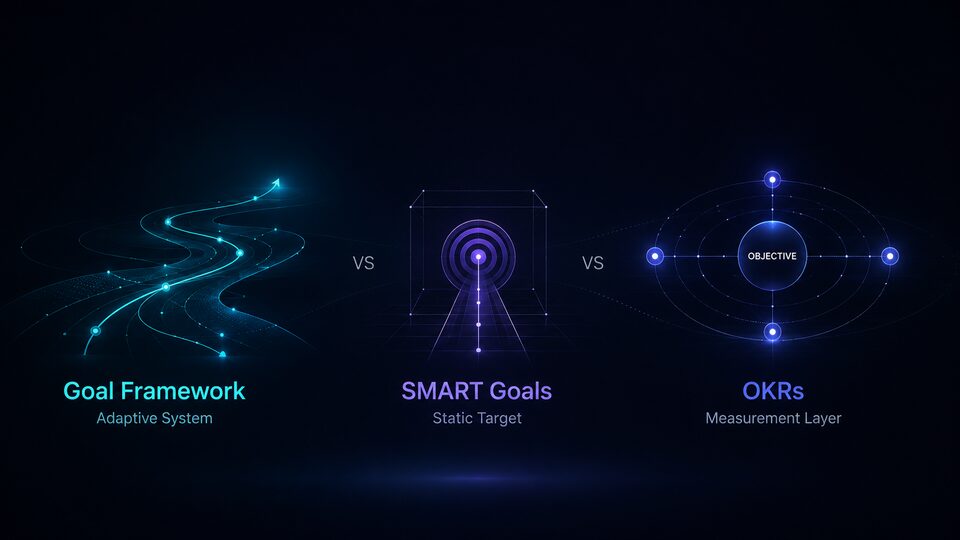
They are better understood as layers.
- SMART goals help you write a clearer target.
- OKRs help you define measurable outcomes for a cycle.
- Goal frameworks help you keep the goal moving when real life gets messy.
That distinction matters because most important goals do not fail because the sentence was unclear. They fail because there is no weekly operating system underneath the sentence.
For career goals, side projects, and product launches, clarity is only the beginning. You also need milestones, visible signals, drift checks, and a next action small enough to take this week.
That is where a live goal framework becomes useful.
The short comparison
Use this split:
| Method | Best for | Weak spot |
|---|---|---|
| SMART goals | Clarifying the target | Does not create a weekly execution rhythm |
| OKRs | Measuring outcome progress over a cycle | Can become a scoreboard without enough behavior underneath |
| Goal framework | Running a goal over time | Can become too heavy if you turn it into a giant planning doc |
A useful goal system may use all three.
For example:
SMART goal
Earn a senior product manager promotion by December by leading one visible launch and improving stakeholder feedback.
OKR
Objective: demonstrate senior-level product leadership this quarter.
Key result 1: launch one cross-functional initiative with measurable adoption.
Key result 2: collect feedback from five senior stakeholders.
Key result 3: produce one promotion evidence packet before calibration.
Goal framework
- Mission: earn senior PM scope by December.
- Milestone 1: clarify the promotion bar with manager and skip-level.
- Milestone 2: lead one visible launch.
- Milestone 3: package evidence before review season.
- Weekly signals: stakeholder updates, evidence notes, decision docs, manager feedback.
- Drift checks: am I guessing the bar, doing invisible work, or waiting too long to collect proof?
- Next action: send manager a promotion-bar agenda this week.
The SMART goal defines the target.
The OKR defines measurable outcomes.
The framework keeps the goal alive.
What SMART goals are good for
SMART stands for specific, measurable, achievable, relevant, and time-bound.
That is useful when a goal is too vague.
Weak:
I want to grow in my career.
Better:
I want to move into a senior data analyst role within 9 months by building two portfolio projects, improving stakeholder storytelling, and applying to targeted roles.
SMART goals force basic clarity:
- What outcome do I want?
- How will I know it happened?
- Is it realistic enough to attempt?
- Why does it matter?
- When should it happen?
That is a real upgrade.
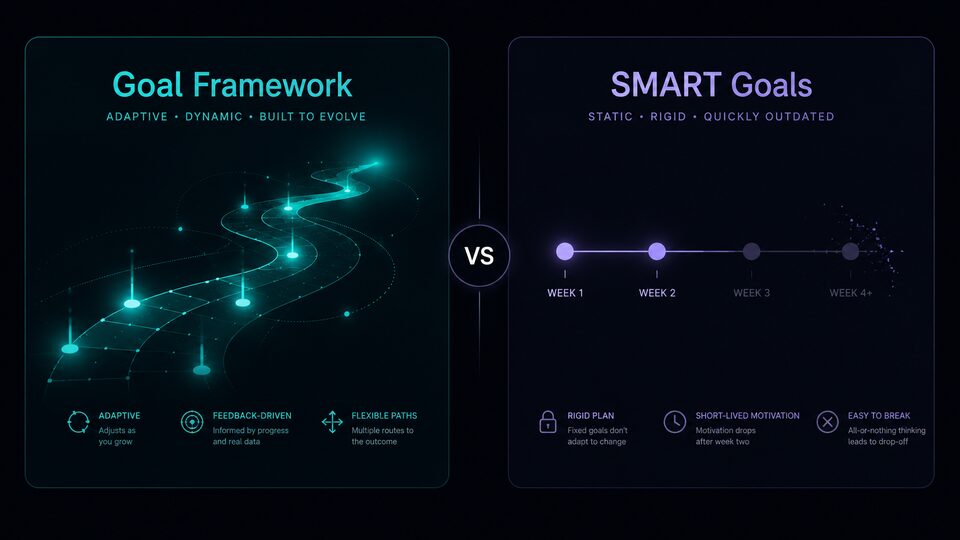
The limitation is what happens after planning day.
A SMART goal does not tell you what to do on Friday when the portfolio project stalled, the manager feedback stayed vague, or the job search became random applications.
It improves the sentence. It does not run the system.
For a deeper comparison, read goal framework vs SMART goals.
What OKRs are good for
OKRs pair a qualitative objective with measurable key results.
They are useful when the question is:
What should change this quarter, and how will we know?
For individuals, OKRs can work well for:
- promotion evidence,
- career transition proof,
- job search pipeline quality,
- side-project launch traction,
- portfolio development,
- skill growth with visible outputs.
Example:
Objective: build a credible product management transition story this quarter.
Key results:
- Complete two case studies based on real product decisions.
- Run six discovery calls with product managers or hiring managers.
- Ship one small product artifact and collect feedback from five users.
That is stronger than a loose intention.
But OKRs can become too outcome-heavy if they do not include the weekly behavior that creates those outcomes.
The key results may be correct, but the person still needs:
- a milestone sequence,
- lead signals,
- drift checks,
- a next action,
- a review rhythm.
Without that, an OKR can become a quarterly scoreboard you only look at when it is already too late.
For the measurement side, see the guide to personal KPIs and OKRs.
What a goal framework adds
A goal framework sits underneath the goal and around the OKR.
It asks:
- What mission are you trying to move?
- What gap must close?
- What milestones reduce uncertainty?
- What weekly signals prove the goal is alive?
- What drift risks usually kill this goal?
- What next action is small enough to do this week?
That makes it especially useful for goals with ambiguity.
Promotion goals are ambiguous because you need visible scope, manager alignment, evidence, timing, and calibration.
Job searches are ambiguous because applications, outreach, positioning, interviews, silence, and feedback all interact.
Side projects are ambiguous because the problem, scope, distribution, feedback, activation, and retention keep changing.
Vibe-coded apps are ambiguous because a demo can feel finished long before onboarding, auth, data cleanup, support, launch, and maintenance are real.
A goal framework gives those messy goals an operating shape.
Want a quick draft? Use the Goal Framework Generator to turn one goal into milestones, weekly signals, drift checks, and next actions.
When to use SMART goals
Use SMART goals when:
- the goal is still fuzzy,
- you need a clean target,
- you are explaining the goal to someone else,
- the outcome is simple enough to define in one sentence,
- you are making a first draft.
SMART is a good doorway.
It is not enough when the goal depends on feedback, visibility, repeated effort, or changing context.
For serious career moves, use SMART as the goal sentence, then put a framework underneath it.
When to use OKRs
Use OKRs when:
- you need a quarterly focus,
- you want measurable outcomes,
- the goal has multiple success indicators,
- you need to separate outcomes from tasks,
- you want a scoreboard for progress.
OKRs are useful for measurement.
They are weaker for daily or weekly execution unless you attach lead indicators and review habits.
A good personal OKR should connect to:
- weekly signals,
- evidence capture,
- milestone dates,
- and one next action.
Otherwise, it can become a polished quarterly promise with no operating rhythm.
When to use a goal framework
Use a goal framework when:
- the goal will take more than a few weeks,
- the work is uncertain,
- motivation will fluctuate,
- progress depends on other people,
- you have failed at this goal before,
- the next action is often unclear,
- you need a weekly recovery mechanism.
That is why a career goal framework is useful for promotion plans, job searches, career changes, side projects, and app launches.
Those goals are not just targets. They are living projects.
They need motion, feedback, and adjustment.
A practical way to combine all three
Here is the simplest stack:
1. Start with SMART for the goal sentence
Write:
I want to [outcome] by [date] by [strategy] because [reason].
Example:
I want to land interviews for senior data analyst roles within 60 days by tightening my positioning, building a targeted company list, and running weekly outreach.
2. Use OKRs for measurable outcomes
Add one objective and two or three key results.
Example:
Objective: build a focused senior data analyst job-search pipeline.
Key results:
- Rewrite resume and LinkedIn for one target role type.
- Build a 30-company target list.
- Complete 12 warm outreach conversations or interview screens.
3. Use a goal framework for weekly execution
Add:
- three milestones,
- two or three weekly signals,
- drift checks,
- one next action.
Example:
Milestones:
- Clarify target role and positioning.
- Build outreach and application assets.
- Run the pipeline and learn from replies.
Weekly signals:
- targeted roles reviewed,
- warm outreach sent,
- interviews or feedback loops completed,
- positioning improved based on responses.
Drift checks:
- Am I applying randomly?
- Did this week improve my story?
- Am I avoiding outreach because applications feel easier?
Next action:
Rewrite the top third of the resume for one target role before sending more applications.
This stack gives you clarity, measurement, and execution.
Common mistake: choosing the method instead of running the goal
The method is not the point.
A clear SMART goal that never gets reviewed will drift.
A beautiful OKR that has no weekly lead indicators will drift.
A goal framework that turns into a huge document will drift too.
The test is simple:
Does this system make the next useful action easier to take?
If yes, keep it.
If no, simplify.
For X18, the useful shape is:
- one mission,
- three milestones,
- weekly signals,
- drift checks,
- one next action,
- a short review loop.
That is enough structure to move, without turning your goal into administrative work.
Build your own live goal framework
If you already have a SMART goal or OKR, convert it into a framework with six lines:
- My mission is…
- The gap I need to close is…
- My three milestones are…
- My weekly signals are…
- My drift risks are…
- My next action is…
Keep it short.
Then review it weekly.
If you want a faster starting point, use the Goal Framework Generator and choose the use case closest to your situation: promotion, job search, side project, or vibe-coded app launch.
X18 is built for the layer after planning day: a live goal framework that keeps career moves and ambitious projects moving after the first burst of motivation fades.