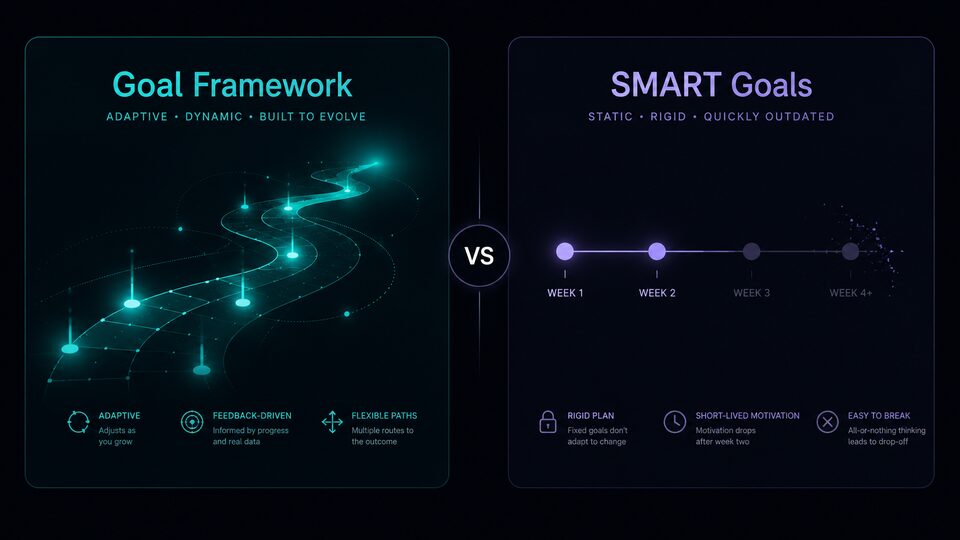

What Is a Goal Framework?
A practical guide for goals that keep drifting after week one.
A goal framework is a repeatable structure for turning a vague intention into something you can actually move.
It usually answers six questions:
- What is the goal?
- Why does it matter now?
- What milestones prove progress?
- What actions happen this week?
- What signals show whether it is working?
- What happens when momentum fades?
Most goal frameworks are good at the first four. The last two are where real life gets messy.
That is why X18 treats a goal framework as something live, not a worksheet you fill out once.
Simple definition
A goal framework is a system that connects your long-term direction to your next action.
A useful framework includes:
- a clear goal statement,
- a realistic time horizon,
- milestones,
- weekly actions,
- progress signals,
- drift risks,
- and a review rhythm.
Without that structure, goals tend to become either too abstract or too fragile.
Too abstract:
“I want to grow my career.”
Too fragile:
“I will spend three hours every night building my portfolio forever.”
A better goal framework turns that into:
“Over the next 30 days, I will build one portfolio case study by completing three focused milestones and reviewing progress every Friday.”
That is specific enough to start, but flexible enough to survive a normal week.
Why people look for goal frameworks
People usually search for a goal framework when motivation is not enough.
They may be trying to:
- get promoted,
- change careers,
- run a job search,
- build a side project,
- learn a difficult skill,
- improve health,
- or organize a messy life transition.
The hidden problem is rarely “I do not know what a goal is.”
The real problem is usually:
“I know roughly what I want, but I do not know how to keep moving when life interrupts.”
That is the gap a good framework should close.
Popular goal frameworks
There are several well-known goal frameworks. Each helps with a different part of the problem.
SMART goals
SMART goals make goals more specific, measurable, achievable, relevant, and time-bound.
Useful for clarity.
Weakness: SMART does not tell you how to recover when the plan starts slipping.
OKRs
OKRs pair one objective with measurable key results.
Useful for outcome focus.
Weakness: OKRs can become a quarterly scoreboard without enough weekly behavior underneath.
KPIs
KPIs track the signals that show whether progress is happening.
Useful for measurement.
Weakness: metrics alone do not create direction or meaning.
Habit systems
Habit systems make repeated behavior easier.
Useful for consistency.
Weakness: many important goals are not just habits. A promotion, job search, or side project needs milestones, decisions, and adaptation.
The missing piece: drift
Most frameworks assume the user will keep following the plan.
That is optimistic.
Real goals drift because:
- the first task was too big,
- the plan stopped matching reality,
- urgent work took over,
- progress was invisible,
- the goal became emotionally heavy,
- or the user did not know what to do next.
This is where a static worksheet fails.
A stronger goal framework should notice drift early and help you recover before the goal quietly dies.
That is the core idea behind X18:
Most goal frameworks stop at planning. X18 keeps yours alive.
If the phrase “goal framework” feels too abstract, the more human version is this: turn a stuck goal into a 90-day execution system.
Want a faster starting point? Use the Goal Framework Generator to turn one promotion, job search, side project, or app launch into a first draft before saving it as a live X18 mission.
A practical goal framework you can copy
Use this structure for one important goal.
1. Name the mission
Write one sentence:
I want to [achieve outcome] by [timeframe] because [reason].
Examples:
- “I want to become a senior engineer within 12 months because I am already operating near that level and need visible proof.”
- “I want to finish one useful side project in 8 weeks because I keep starting ideas without shipping.”
- “I want to run a focused job search for 30 days because I need better options before my current role burns me out.”
2. Pick three milestones
Do not create a giant roadmap. Pick three stages.
Example for a promotion goal:
- Clarify the promotion bar.
- Build evidence through one visible project.
- Package results for manager review.
Example for a side project:
- Define one painful problem.
- Ship a rough version.
- Get five real users or conversations.
3. Choose weekly signals
Signals show whether the goal is still alive.
Good signals are mostly under your control:
- deep work hours,
- outreach messages,
- drafts finished,
- feedback conversations,
- experiments shipped,
- applications sent,
- portfolio artifacts created.
Keep it to two or three. More is not better.
4. Define drift risks
Ask:
What usually makes this kind of goal stall?
Common answers:
- unclear next step,
- no time block,
- perfectionism,
- lack of feedback,
- too many competing goals,
- no visible progress.
Name the risk before it happens. That makes it easier to catch.
5. Choose the next action
A next action should be small enough to do this week.
Bad:
Build my portfolio.
Better:
Write the rough outline for one case study and send it to one trusted reviewer.
Bad:
Get promoted.
Better:
Ask my manager which two promotion signals matter most this quarter.
Static framework vs live framework
A static goal framework gives you structure once.
A live goal framework keeps asking:
- Is the goal still clear?
- Is the plan still realistic?
- Did anything move this week?
- Are there signs of drift?
- What is the next action now?
That difference matters.
A calendar tool can manage your day. A task manager can store work. A notes app can hold your plans.
But the goal itself still needs continuity.
That is what X18 is built for: keeping one meaningful goal alive after the planning energy fades.
Example: career goal framework
Goal:
Become a senior engineer within 12 months.
Milestones:
- Clarify expectations with manager.
- Lead one cross-team technical project.
- Collect evidence and feedback.
Weekly signals:
- 4 hours of senior-scope project work,
- 1 stakeholder update,
- 1 piece of evidence captured.
Drift risks:
- waiting for permission,
- doing invisible work,
- not collecting feedback until too late.
Next action:
Schedule a 30-minute conversation with my manager to confirm the two most important promotion signals for this quarter.
Example: side project goal framework
Goal:
Ship one useful side project in 8 weeks.
Milestones:
- Pick one painful problem.
- Build the smallest useful version.
- Get five people to try it.
Weekly signals:
- 3 focused build sessions,
- 1 user conversation,
- 1 shipped improvement.
Drift risks:
- overbuilding,
- changing ideas too often,
- avoiding distribution.
Next action:
Write a one-sentence promise for the project and send it to three people who might care.
The best goal framework is the one you keep using
A goal framework should reduce friction, not create a second job.
If your framework takes more time to maintain than the goal itself, it will probably fail.
Start simple:
- one goal,
- three milestones,
- two weekly signals,
- one review rhythm,
- one next action.
Then keep it alive.
X18 helps with that second part: turning the framework into a live mission, tracking health and drift, and surfacing the next action when momentum starts to fade.
Start your first X18 mission