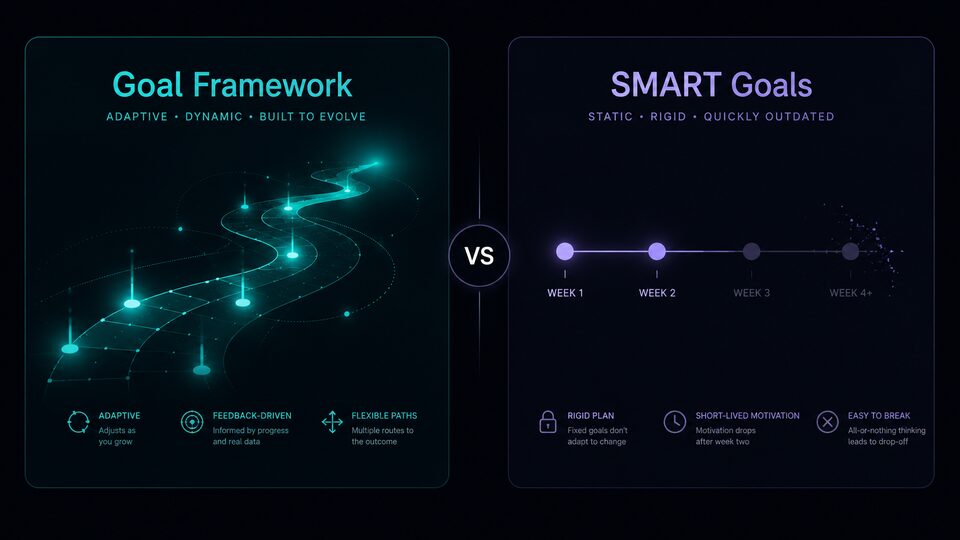

How to Set Career Goals That Actually Work
Most career goals sound sensible on the day you write them.
Get promoted this year.
Find a better job.
Move into product.
Build a portfolio that proves I can do the next role.
The problem usually arrives one or two Mondays later. The goal still matters, but the next action is vague. Work is busy. The manager meeting gets postponed. The job search tab stays open. The portfolio case study is “almost started.” Nothing looks broken, but nothing is really moving.
That is the part most career goal advice skips.
Setting the goal is easy. Keeping it alive after the first burst of motivation is the real work.
The common mistake
Most people set career goals as if clarity is the whole problem.
They make the goal more specific:
Become a senior engineer in 12 months.
They make it measurable:
Lead two cross-team projects and mentor two engineers.
They add a deadline:
By the next review cycle.
That is better than “grow my career,” but it is still not enough. A clearer sentence does not tell you what to do this week. It does not warn you when the goal is drifting. It does not collect proof while the work is fresh.
A career goal that actually works needs four things:
- A real career outcome.
- Proof that would make the outcome credible.
- Weekly signals that show the goal is still moving.
- Drift checks that tell you when to recover early.
The goal sentence matters. The operating system underneath it matters more.
Start with the career situation, not the framework
Do not begin by asking, “Should I use SMART goals, OKRs, or KPIs?”
Begin with the situation you are actually in.
If you want a promotion
The useful question is:
What proof would make the promotion case obvious to my manager?
Not:
How do I become more senior?
Promotion goals need visible proof: ownership, scope, decision quality, stakeholder trust, measurable impact, or leadership behavior. If those things are not being captured every week, the goal can look active while the promotion case stays thin.
If you want a new job
The useful question is:
Which role am I trying to become the obvious candidate for?
Not:
How many applications did I send?
Job-search goals need positioning, market feedback, targeted outreach, interview stories, and a pipeline that teaches you something. Application volume alone can hide a weak story.
If you want to change career direction
The useful question is:
What evidence would make this move believable to someone who does not already know me?
Not:
What course should I take next?
Career-change goals need proof of the new identity: projects, case studies, shipped work, public artifacts, conversations, and feedback from people already in the target field.
The point is simple: a good career goal starts from the buyer of the proof. Your manager, hiring manager, client, mentor, or future self needs evidence. The plan should produce that evidence on purpose.
Turn the goal into a 90-day outcome
Twelve-month goals are useful for direction, but they are too far away for weekly execution. X18 works better when the first version is a 90-day outcome.
Weak:
Get promoted this year.
Stronger:
In 90 days, create visible proof in two senior-level scope areas and review the gaps with my manager before the promotion packet is due.
Weak:
Find a better job.
Stronger:
In 90 days, build a focused job-search pipeline for one target role family, improve my positioning from market feedback, and generate qualified interviews.
Weak:
Move into product management.
Stronger:
In 90 days, ship one product case study, run one small discovery-to-decision project, and get feedback from three PMs or hiring managers.
A 90-day outcome is long enough to produce proof and short enough to review honestly.
Pick three milestones that prove movement
Milestones should not be decorative phases like “research,” “execute,” and “optimize.” They should prove that something changed.
For a promotion goal:
- Clarify the next-level bar with your manager.
- Build proof in two high-leverage areas.
- Package the story before review season.
For a job search:
- Choose one target role family and rewrite the positioning around it.
- Run targeted applications plus outreach for four weeks.
- Use replies, rejections, and conversations to improve the story.
For a career switch:
- Choose the target role and name the credibility gap.
- Build one artifact that closes part of the gap.
- Put the artifact in front of people who can judge it.
If a milestone does not create proof, feedback, or a decision, it is probably just a task group.
Choose weekly signals you can actually control
Weekly signals are the difference between a career goal and a wish.
Bad signal:
I feel like I am making progress.
Better signal:
I captured one proof bullet with scope, action, result, and stakeholder.
Bad signal:
I applied to jobs.
Better signal:
I sent five targeted applications, two warm outreach messages, and recorded which version of my positioning got a reply.
Bad signal:
I worked on my portfolio.
Better signal:
I published one rough case-study section and asked two people in the target role what still feels unconvincing.
Good career signals are visible, countable, and connected to evidence. They should be small enough to survive a normal week, because normal weeks are where goals usually disappear.
Write the drift checks before the drift happens
This is where most career plans are too polite.
You need warning signs.
For a promotion:
- I did useful work but captured no proof.
- I avoided asking my manager what is missing.
- I stayed busy with delivery that does not show next-level scope.
- I waited for review season instead of creating signal now.
For a job search:
- I sent more applications without narrowing the target role.
- I changed my resume again but got no outside feedback.
- I avoided outreach because it felt awkward.
- I counted activity but learned nothing from the market.
For a career switch:
- I consumed another course instead of making proof.
- I built something private but showed nobody.
- I described the transition in vague language.
- I avoided people who could give uncomfortable feedback.
Drift checks are not guilt. They are recovery handles. If one shows up, the next action should get smaller and more concrete.
Decide the next action for this week
The next action should be boringly specific.
Not:
Work on promotion.
Better:
Write one proof bullet from this week: situation, action, result, stakeholder, next-level signal.
Not:
Improve my job search.
Better:
Pick one target role family and remove three resume bullets that do not support that story.
Not:
Start my portfolio.
Better:
Draft the before/after section of one case study and send it to one person for feedback.
If the next action cannot be done this week in less than 90 minutes, it is probably still too large.
A worked example: promotion goal
Here is the difference between a normal career goal and an execution-ready one.
Goal sentence
Get promoted to senior engineer in the next review cycle.
90-day outcome
Create visible proof for senior-level ownership by clarifying the bar, leading one cross-team delivery area, and reviewing the evidence with my manager before packet season.
Milestones
- Clarify the senior bar and choose two proof areas.
- Ship or unblock one scope-expanding project.
- Draft the promotion story with evidence while details are fresh.
Weekly signals
- One proof bullet captured.
- One stakeholder or manager signal recorded.
- One next-level scope action moved.
- One blocker or ambiguity resolved.
Drift checks
- I am doing more work but not more visible work.
- My manager has not seen the evidence.
- I cannot explain what this week proved.
- I am waiting for the review cycle to create the story.
Next action
Before Friday, write three proof bullets from the last month and ask my manager which one best matches the senior bar.
That is not motivational. It is usable. That is the point.
Quick career goal worksheet
Copy this into a note before you use any tool:
| Section | Your answer |
|---|---|
| Career situation | Promotion, job search, career switch, portfolio, leadership growth |
| 90-day outcome | What should be visibly different in 90 days? |
| Buyer of proof | Manager, hiring manager, client, mentor, audience |
| Three milestones | Proof, feedback, or decision points |
| Weekly signals | 2-4 actions or evidence points you can control |
| Drift checks | Warning signs that the goal is going quiet |
| Next action | One action under 90 minutes |
Keep it short. The goal is not to admire the plan. The goal is to run it next week.
Turn it into a plan
If you want a faster first draft, use the 90-Day Execution Plan Generator to turn one career goal into milestones, weekly signals, drift checks, and next actions.
After the preview is useful, save it as a live X18 mission so the goal has somewhere to keep moving after planning day.