
Career Goal Framework
A practical system for career moves that need more than a written goal.
A career goal framework is the structure that turns a career ambition into weekly progress.
It is useful when the goal is too important to leave as a vague sentence:
- “I want to get promoted.”
- “I need a better job.”
- “I want to change career direction.”
- “I should finally ship this side project.”
- “I need to turn this prototype into something real.”
Those goals sound clear when you say them once. Then a normal week happens. Your manager gives vague feedback. Applications scatter across tabs. A side project loses energy after Monday. A promising app needs onboarding, auth, support, launch work, and actual users.
The problem is not that you lack ambition. The problem is that career goals drift unless they have an operating system.
That is what a career goal framework is for.
What is a career goal framework?
A career goal framework is a live plan that connects a career outcome to the work you can do this week.
At minimum, it should define:
- The career outcome you want.
- Why it matters now.
- The milestones that prove progress.
- The weekly signals that show motion.
- The risks that usually make this goal drift.
- The next action small enough to take this week.
The word “framework” matters because career goals rarely move in a straight line.
A promotion goal depends on manager expectations, visible scope, evidence, timing, and calibration. A job search depends on positioning, targeted roles, outreach, interviews, feedback, and follow-up. A side project depends on energy, scope, shipping rhythm, first users, and retention.
A static goal statement cannot carry all of that.
A career goal framework can.
Want to build one quickly? Start with the Goal Framework Generator and turn one career goal into milestones, signals, drift checks, and next actions before saving it as a live X18 mission.
When to use a career goal framework
Use a career goal framework when the goal has more moving parts than a habit tracker can handle.
It is especially useful for career moves like:
- getting promoted,
- changing teams,
- finding a better job,
- preparing for a performance review,
- moving into a new role type,
- building a portfolio,
- launching a side project,
- or turning a vibe-coded prototype into a maintained app.
These goals have two things in common.
First, they require visible proof. You need evidence, artifacts, conversations, shipped work, or market feedback.
Second, they are easy to postpone. There is usually no single deadline forcing you to act this week.
That combination is dangerous. Important, ambiguous goals are the easiest ones to let drift.
The six parts of a strong career goal framework
Here is a simple structure you can copy.
1. Mission
Write the goal as a mission, not a wish.
Weak:
I want to grow in my career.
Better:
I want to earn a senior product manager promotion by December by clarifying the promotion bar, leading one visible launch, and packaging evidence before review season.
Weak:
I want a new job.
Better:
I want to land interviews for senior data analyst roles in the next 60 days by tightening my positioning, applying to targeted companies, and building a weekly outreach rhythm.
The mission should be specific enough to guide action, but not so rigid that one messy week breaks it.
2. Role delta
A career goal usually has a gap between where you are now and where you want to be.
Name that gap.
For a promotion, the gap might be:
- higher ownership,
- stronger stakeholder trust,
- more strategic judgment,
- clearer business impact,
- or visible leadership beyond your direct tasks.
For a job search, the gap might be:
- unclear target role,
- weak resume positioning,
- no portfolio proof,
- scattered applications,
- or too little warm outreach.
For a side project, the gap might be:
- no sharp user problem,
- too much scope,
- no shipping rhythm,
- no first-user feedback,
- or no distribution plan.
The role delta keeps the framework honest. It stops the plan from becoming busywork.
3. Milestones
Pick three milestones, not twelve.
A promotion framework might use:
- Clarify the promotion bar with your manager.
- Create visible impact through one scoped project.
- Package evidence before review season.
A job search framework might use:
- Choose a target role and rewrite positioning.
- Build a 30-company pipeline with outreach.
- Convert interviews into learning loops.
A side project framework might use:
- Define one painful problem and one useful MVP.
- Ship something inspectable.
- Get first-user feedback and improve retention.
Milestones should reduce uncertainty. If a milestone does not change what you know or what becomes possible, it is probably a task wearing a bigger name.
4. Weekly signals
Weekly signals tell you whether the goal is still alive.
Good career signals are concrete:
- evidence captured,
- manager conversations booked,
- stakeholder updates sent,
- portfolio drafts published,
- targeted applications sent,
- warm outreach replies,
- interviews completed,
- user feedback conversations,
- product improvements shipped.
Bad signals are vague:
- “felt productive”,
- “thought about it”,
- “worked on career stuff”,
- “made progress.”
The best signals are visible enough that you can review them on Friday without negotiating with yourself.
5. Drift checks
Drift is what happens when the goal is technically still important, but no longer moving.
Career goals drift in predictable ways.
Promotion goals drift when you keep doing good work but fail to make the promotion bar explicit. Job searches drift when application volume replaces targeted positioning. Side projects drift when building becomes a hiding place from users. Vibe-coded apps drift when a demo feels complete but onboarding, data cleanup, activation, and support are ignored.
Write the drift checks before you need them:
- Am I waiting for clarity I have not asked for?
- Did this week create visible proof?
- Is my next action under 90 minutes?
- Did I get feedback from a person, or only improve the plan?
- Is this goal simpler than last week, or heavier?
A good drift check is not a guilt prompt. It is an early warning system.
6. Next action
The next action should be boringly specific.
Bad:
Work on my promotion.
Better:
Send my manager three bullet points asking what senior-level evidence would matter most this quarter.
Bad:
Apply to jobs.
Better:
Rewrite the top third of my resume for senior data analyst roles, then send it to two former coworkers for feedback.
Bad:
Launch my app.
Better:
Write the first-user onboarding checklist and test it with one person who has never seen the product.
If the next action is too large to do on a tired weekday evening, it is not the next action yet.
Example: promotion career goal framework
Promotion goals fail quietly because people wait too long to make expectations explicit.
A stronger framework might look like this:
- Mission: earn senior-level scope before the next review cycle.
- Role delta: move from reliable execution to visible ownership and cross-functional judgment.
- Milestone 1: clarify the promotion bar with manager and skip-level.
- Milestone 2: lead one project with measurable business impact.
- Milestone 3: package evidence before the review packet is due.
- Weekly signals: evidence notes captured, stakeholder updates sent, manager feedback requested.
- Drift checks: am I doing invisible work, guessing the bar, or waiting until review season?
- Next action: book the promotion-bar conversation this week.
For a deeper page on this use case, see build a promotion framework.
Example: job search career goal framework
Job searches often drift because activity feels like progress even when it is not targeted.
A stronger framework:
- Mission: build a focused pipeline for the next role within 60 days.
- Role delta: move from “open to anything” to a clear target role and credible story.
- Milestone 1: choose target roles and rewrite positioning.
- Milestone 2: build a company list and outreach rhythm.
- Milestone 3: turn interviews, rejections, and silence into weekly learning.
- Weekly signals: targeted applications, warm outreach, replies, interviews, positioning changes.
- Drift checks: am I applying randomly, avoiding outreach, or failing to learn from responses?
- Next action: choose 20 target companies and write one role-specific positioning paragraph.
For the full version, see plan a focused job search.
Example: side project or app launch framework
Side projects and prototypes are career goals too when they create proof of taste, execution, judgment, or product skill.
A stronger framework:
- Mission: ship one useful project that real people can try.
- Role delta: move from builder energy to product ownership.
- Milestone 1: cut the scope to one painful problem.
- Milestone 2: ship an inspectable MVP.
- Milestone 3: learn from first users and improve retention.
- Weekly signals: shipped changes, user conversations, onboarding fixes, activation events.
- Drift checks: am I adding features instead of reducing uncertainty?
- Next action: define the first-user experience and ask one person to try it.
If the project is still early, start with turn a side project into a mission. If the prototype already exists, use turn a vibe-coded app into a launch plan.
Career goal framework vs SMART goal vs career plan
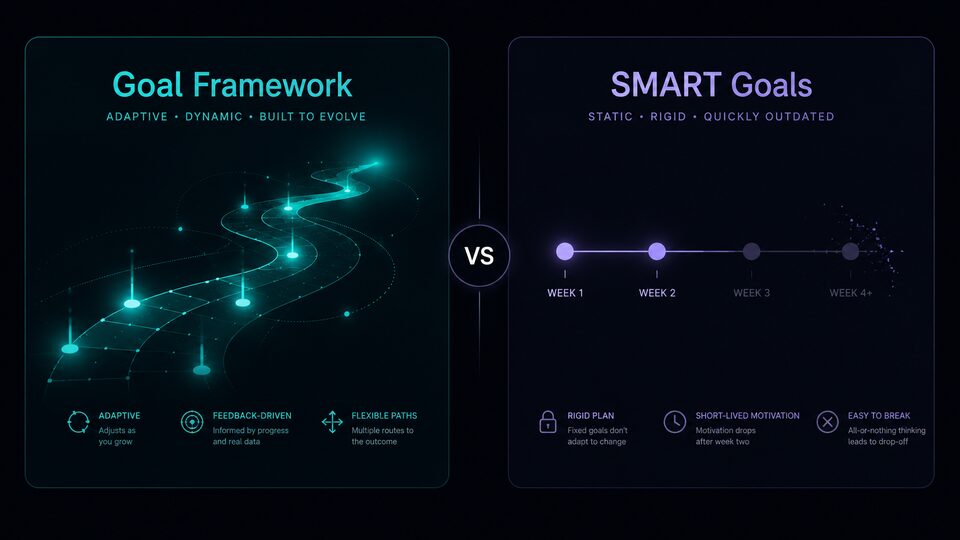
A SMART goal helps you write the target clearly.
A career plan usually describes the bigger path.
A career goal framework sits between them. It turns the target and the path into a system you can run each week.
Simple split:
- SMART goal: “What exactly do I want?”
- Career plan: “Where might this lead over time?”
- Career goal framework: “What milestones, signals, drift checks, and next actions keep this moving now?”
That is why a framework is often more useful for live career moves than a one-time planning exercise.
For more detail, read goal framework vs SMART goals and the broader guide to what a goal framework is.
Build your own career goal framework
You can start manually with six lines:
- My mission is…
- The role delta is…
- My three milestones are…
- My weekly signals are…
- My drift risks are…
- My next action is…
Keep it short. The goal is not to create a beautiful plan. The goal is to create a plan that survives next week.
If you want a faster draft, use the Goal Framework Generator and choose the use case closest to your situation: promotion, job search, side project, or vibe-coded app launch.
Then explore the framework library to see how X18 turns career goals into live missions that keep adapting after planning day.