
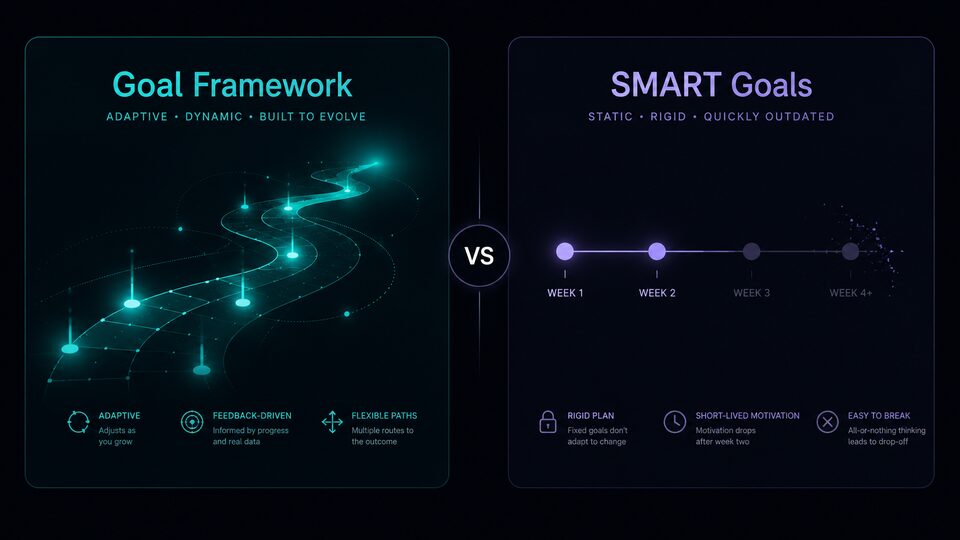
Goal Framework vs SMART Goals
SMART goals help you define the target. A goal framework helps you keep the target alive.
SMART goals are useful.
They push you to make a goal specific, measurable, achievable, relevant, and time-bound. That is better than writing “I want to grow” and hoping motivation does the rest.
But SMART goals have a quiet weakness:
They improve the sentence, not the system.
That matters because most important goals do not fail on planning day. They fail after the first or second week, when the plan meets real work, tired evenings, vague feedback, delayed replies, and competing priorities.
That is where a goal framework becomes more useful.
A goal framework turns the goal into a living structure: milestones, weekly signals, drift checks, and next actions. It does not just ask whether the goal is well written. It asks whether the goal is still moving.
The short version
Use SMART goals when you need clarity.
Use a goal framework when you need execution.
For example:
SMART goal
Get promoted to senior product manager by December by leading one strategic launch and improving stakeholder feedback scores.
That is clear. Good start.
Goal framework
- Mission: earn senior product manager scope by December.
- Milestone 1: clarify the promotion bar with manager and skip-level.
- Milestone 2: own one visible launch with measurable business impact.
- Milestone 3: package evidence before review season.
- Weekly signals: stakeholder updates sent, decision docs shipped, feedback captured.
- Drift risks: waiting too long for manager clarity, doing invisible work, collecting evidence only at the end.
- Next action: book the promotion-bar conversation this week.
The SMART version defines success.
The framework creates motion.
What SMART goals do well
SMART goals are popular for a reason. They force useful pressure into fuzzy ideas.
Instead of:
I want a better career.
You write:
I want to move into a senior data analyst role within 9 months by building two portfolio projects, improving stakeholder storytelling, and applying to 20 targeted roles.
That is better because it answers:
- What outcome do I want?
- How will I know it happened?
- Is the goal realistic?
- Why does it matter?
- When should it happen?
For many people, that alone is a big upgrade.
The problem is what happens next.
SMART does not tell you what to do this Friday when the portfolio project stalled, your manager gave vague feedback, or the job search became random applications.
It makes the destination clearer. It does not run the trip.
Why static goals fail after week two
Most goals feel strongest when they are new.
You have energy. The plan is clean. The future version of you seems strangely available every evening.
Then week two arrives.
The first draft is harder than expected. The stakeholder does not reply. Your manager says “keep doing what you are doing” instead of naming the promotion bar. The side project has a boring infrastructure problem. The job search starts to feel like sending your resume into a wall.
At that point, the issue is rarely that the goal was not SMART enough.
The issue is that the goal has no operating rhythm.
Common failure modes:
- The next action is too large.
- Progress is invisible.
- The goal depends on feedback you have not requested.
- The plan assumes perfect weekly energy.
- There is no signal telling you when the goal is drifting.
- Review happens at the end, when it is too late to recover.
This is especially obvious with career goals.
Promotion goals drift because people wait until review season to gather evidence. Job searches drift because “apply to jobs” turns into unfocused volume. Side projects drift because building feels productive even when nobody is seeing the product.
SMART goals do not catch those problems early.
A live framework can.
What a goal framework adds
A goal framework keeps the useful part of SMART goals, then adds the missing execution layer.
It should answer six questions:
- What is the goal?
- Why does it matter now?
- What milestones prove progress?
- What actions happen this week?
- What signals show whether it is working?
- What happens when momentum fades?
That last question is the difference.
Most planning tools act like motivation is stable. It is not.
Your framework should expect drift and make recovery normal.
For a promotion goal, drift checks might include:
- Did I capture evidence this week, or am I trusting myself to remember it later?
- Did I get manager feedback on the promotion bar, or am I guessing?
- Did I ship visible work, or only invisible effort?
- Is my next action under 90 minutes?
For a job search:
- Did I send targeted outreach, or only applications?
- Did I learn anything from the last five rejections or silences?
- Is my positioning clearer than last week?
- Am I tracking quality conversations, not just application count?
For a side project:
- Did I speak to a real user?
- Did I ship something inspectable?
- Did this week reduce uncertainty?
- Is the project getting simpler or heavier?
Those signals make the goal alive.
SMART goal vs goal framework: the practical difference
Here is the simplest way to separate them.
SMART goals are a definition tool
They help you write a goal that is less vague.
Good for:
- turning an intention into a clear outcome,
- deciding what success means,
- setting a deadline,
- checking whether the goal is realistic.
Weak for:
- weekly execution,
- recovery after missed weeks,
- deciding the next action,
- noticing hidden drift.
Goal frameworks are an operating tool
They help you run the goal over time.
Good for:
- breaking the goal into milestones,
- choosing weekly signals,
- tracking drift risks,
- turning review into adjustment,
- keeping the next action small enough to start.
Weak for:
- instant simplicity, if you overbuild it.
That last point matters. A goal framework should not become a giant productivity spreadsheet. If it takes more energy to maintain than the goal itself, it is broken.
The right version is lightweight:
- one mission,
- three milestones,
- two or three weekly signals,
- a short drift check,
- one next action.
Example: promotion goal
Static SMART goal:
Get promoted to engineering manager by December by leading a cross-team initiative and improving team delivery predictability.
Live goal framework:
Mission: earn engineering manager scope by December.
Milestone 1: clarify the promotion bar with manager and skip-level.
Milestone 2: lead one cross-team delivery with measurable improvement.
Milestone 3: package evidence and feedback before review calibration.
Weekly signals:
- one stakeholder update sent,
- one coaching or delegation moment captured,
- one concrete evidence note added.
Drift checks:
- Am I doing manager-level work, or only doing more IC work?
- Do the right people see the evidence?
- Have I asked what would make the promotion obvious?
Next action:
Send manager a short agenda for a promotion-bar conversation.
That is much harder to ignore than a clean goal statement sitting in a note.
Example: job search goal
Static SMART goal:
Find a better product role within 90 days by applying to 40 relevant jobs and completing 10 networking conversations.
Live goal framework:
Mission: land a better product role in 90 days.
Milestone 1: sharpen positioning for one target role type.
Milestone 2: create proof assets: resume, case study, outreach message.
Milestone 3: run a weekly pipeline of targeted applications and conversations.
Weekly signals:
- five high-fit roles reviewed,
- three targeted outreaches sent,
- one positioning improvement made.
Drift checks:
- Am I applying randomly because it feels productive?
- Did I improve the message based on replies?
- Is my search narrower than last week?
Next action:
Rewrite the top third of the resume for one target role before sending more applications.
The SMART version says what success looks like.
The framework improves the search every week.
When to use each one
Use SMART goals when:
- you are still clarifying the outcome,
- the goal is short and simple,
- you need to explain the target to someone else,
- you are creating a first draft.
Use a goal framework when:
- the goal will take more than a few weeks,
- the work has uncertainty,
- progress depends on other people,
- you have failed at this goal before,
- you need a weekly rhythm, not just a deadline.
Most career goals belong in the second category.
Getting promoted, changing roles, launching a side project, and building a product are not single tasks. They are adaptive projects. They need visible progress, feedback loops, and recovery points.
That is why X18 is built around the idea of a live goal framework.
A simple framework you can copy today
Take one goal and write:
1. Goal sentence
Use SMART if it helps:
I want to [outcome] by [date] because [reason].
2. Three milestones
Name the stages:
- Clarify.
- Build evidence.
- Package or ship.
Adjust those labels to your goal.
3. Weekly signals
Pick two or three signs that the goal is alive.
Examples:
- evidence notes captured,
- stakeholder conversations,
- focused work blocks,
- outreach messages,
- user conversations,
- shipped improvements.
4. Drift risks
Write the ways this goal usually dies.
Examples:
- I wait too long for feedback.
- I keep planning instead of shipping.
- I apply randomly.
- I do invisible work.
- I skip the weekly review.
5. Next action
Make it small enough to do this week.
If the next action is bigger than 90 minutes, split it.
The real comparison
The question is not whether SMART goals are bad.
They are fine. They are useful.
The question is whether a clear goal is enough.
For serious goals, it usually is not.
A SMART goal can make the target sharper. A goal framework can make the work survivable.
And when the goal starts drifting, survivable matters more than elegant.
Want a fast starting point? Use the Goal Framework Generator to turn one promotion, job search, side project, or app launch into a practical framework you can save as a live X18 mission.