
The 10 Best Goal Setting Tools in 2026
The useful question is not just where to write the goal. It is what keeps the goal alive after the first planning session.
A good goal-setting tool has to survive the second week.
That is where most goals get quiet. The goal still matters, but the next action is vague. The review meeting gets delayed. The side project is “almost ready.” The job search has activity but no signal. The spreadsheet still exists, but nobody opens it.
This is why choosing a goal-setting tool is not only a software decision. It is a follow-through decision.
Research on goal failure and goal adjustment points to a familiar human problem: missing a goal does not only affect the task; it can affect motivation, self-evaluation, and whether you keep pushing or adjust the goal. A tool that only stores the original intention does not help much at that moment.
So this list ranks tools by a practical standard:
Which tool helps the goal keep moving after motivation fades?
That means the ranking favors tools that connect goals to milestones, weekly check-ins, progress signals, and recovery. If you only need a blank place to write an objective, Google Docs or Notion may be enough. If you need company OKRs, choose a team goal platform. If you need one important career move, job search, side project, or app launch to keep moving, you probably need a live goal framework.
Quick Comparison
| Tool | Best for | Main strength | Main caveat |
|---|---|---|---|
| X18 | Keeping one important mission alive | Goal framework, milestones, weekly signals, drift checks | Narrower than a broad task suite |
| ClickUp Goals | Team and power-user goal tracking | Goals connected to targets, tasks, dashboards | Can feel heavy for personal goals |
| Asana Goals | Company goal alignment | Ownership, reporting, team visibility | Built more for organizations than solo missions |
| Tability | Lightweight OKR check-ins | Outcome tracking and review cadence | More team/OKR oriented |
| GoalsOnTrack | Classic personal goal planning | SMART goals, subgoals, habits, progress | Less focused on drift and recovery |
| Weekdone | Weekly OKR rhythm | Plans, progress, problems, feedback | Mostly a team operating system |
| Notion | Flexible goal dashboards | Templates, databases, notes | You build the system yourself |
| Todoist | Task-first execution | Projects, reminders, recurring actions | Not a full goal framework |
| Strides | Habit and personal tracking | Charts, reminders, SMART goals, streaks | Weaker for complex missions |
| Google Docs / Sheets | Free baseline | Flexible, familiar, shareable | No native accountability loop |
How To Choose A Goal-Setting Tool
Before choosing a tool, decide what kind of goal you are managing.
Choose a live goal framework if the goal is important and messy
This fits goals like:
- get promoted this year;
- find a better job;
- launch a side project;
- turn a prototype into a real app;
- change career direction without losing momentum.
These goals need milestones, weekly signals, drift checks, and next actions. A list of tasks is not enough because the plan will change as reality pushes back.
Choose an OKR tool if the goal belongs to a team
If the goal needs ownership, visibility, reporting, quarterly reviews, and cross-functional alignment, a team OKR tool makes sense.
Choose a habit tracker if the goal is repetitive
If the goal is daily reading, training, writing, sleep, language practice, or a measurable routine, a habit tracker may be better than a project-management system.
Choose a document or spreadsheet if you need a blank canvas
Sometimes the best first tool is the simplest one. A document or spreadsheet is fine if you mainly need to think, share, and sketch.
The weakness is follow-through. Blank canvases do not remind you when the goal is drifting.
1. X18 - Best Live Goal Framework For One Important Mission
X18 is best when you do not just want to write a goal. You want to turn it into a live mission that keeps moving.
The product is built around a specific idea: important goals need an operating system. In X18, a goal becomes a mission with milestones, weekly signals, drift checks, and next actions. That makes it a better fit for career moves, job searches, side projects, app launches, and other goals where the hard part is not the first plan. It is the follow-through.
This is the core difference between X18 and a normal task app. A task app asks, “What is on the list?” A live goal framework asks, “Is the mission still moving?”
X18 is especially useful if your goal has uncertainty:
- you do not know what proof your promotion needs;
- your job search has activity but no replies;
- your side project has code but no users;
- your app demo works, but the product is not launchable yet.
In those cases, the goal needs more than a due date. It needs a structure that can notice drift early and convert the next week into something visible.
Best for: people who want one meaningful goal to survive real life.
Not ideal for: teams that mainly need company-wide OKR reporting or large project-management workflows.
Useful X18 links:
2. ClickUp Goals - Best Goal-To-Work Connection For Teams And Power Users
ClickUp Goals is strong when goals need to connect directly to projects, tasks, dashboards, and team execution.
ClickUp lets users create goals and targets, including different target types such as number, true/false, currency, and task targets. That makes it useful when the goal is already part of a larger workspace and you want progress to be visible alongside the work.
The tradeoff is setup weight. ClickUp can do a lot, which is useful for teams and power users, but it may be more system than a solo user needs for one personal goal.
Best for: teams, operators, and power users who already run work in ClickUp.
Not ideal for: someone who wants a simple guided path from one personal goal to weekly execution.
Official links:
3. Asana Goals - Best For Company Goal Alignment
Asana Goals is built for organizations that need goal ownership, visibility, and reporting.
It makes sense when leaders, managers, and teams need to see how work connects to larger objectives. This is different from a personal goal tracker. The main problem Asana Goals solves is alignment: what are we trying to achieve, who owns it, how does progress roll up, and what is at risk?
For company goals, that is valuable. For a solo career or side-project mission, it may be too organizational.
Best for: companies and teams that need shared goal reporting.
Not ideal for: personal goals where the main challenge is maintaining momentum outside a team process.
Official links:
4. Tability - Best Lightweight OKR Check-In Tool
Tability is a modern OKR and goal-tracking tool built around outcomes, check-ins, and reporting.
It is a good fit when the goal needs a regular review cadence but you do not want the heaviness of a full project-management suite. Tability’s positioning around goal tracking, OKRs, and AI-assisted goal work makes it a strong 2026 contender, especially for teams that want goals to stay current.
Compared with X18, Tability feels more team/outcome/OKR oriented. X18 is more focused on an individual’s live mission and weekly goal drift.
Best for: teams that want lightweight OKR tracking and check-ins.
Not ideal for: someone who wants a personal mission-control layer rather than an OKR process.
Official links:
5. GoalsOnTrack - Best Classic Personal SMART Goal System
GoalsOnTrack is one of the more dedicated personal goal-setting tools on this list.
It is built around goal planning, SMART goals, subgoals, action plans, habits, progress tracking, and motivation tools. If you want a classic goal-setting system that is more structured than a spreadsheet, GoalsOnTrack is worth considering.
Its strength is that it treats personal goals as the main object, not as a side feature inside a task manager. Its limitation is that the positioning feels more classic: goal, plan, habit, progress. X18 is more explicitly about a live mission with drift and recovery.
Best for: personal goal planning with SMART goals, habits, and progress tracking.
Not ideal for: users who want goal drift and recovery to be the central product metaphor.
Official links:
6. Weekdone - Best Weekly OKR Rhythm For Small Teams
Weekdone is useful because it takes the weekly rhythm seriously.
Many goals fail because nobody reviews them until it is too late. Weekdone’s structure around OKRs, weekly plans, progress, problems, and feedback helps teams keep objectives visible in the normal cadence of work.
This is especially useful for small teams that want a lightweight operating rhythm. For a solo user, it may feel too team-based, but the underlying idea is important: goals need review loops.
Best for: teams that want weekly OKR updates and feedback.
Not ideal for: personal goals that do not need team reporting.
Official link:
7. Notion - Best Flexible Goal-Planning Workspace
Notion is one of the easiest recommendations because many people already use it.
You can create goal dashboards, databases, review pages, journals, project trackers, and templates. If your goal-setting system needs to be flexible and customized, Notion is excellent.
The caveat is that Notion does not automatically solve follow-through. A beautiful dashboard can still go stale. You have to design the review loop, maintain the database, and decide what happens when the goal starts drifting.
Best for: flexible goal dashboards, docs, and templates.
Not ideal for: people who need the tool to actively guide weekly execution and recovery.
Official links:
8. Todoist - Best Task-First Goal Execution App
Todoist is not only a goal-setting app, but it is excellent at turning goals into actions.
If your goal can be broken into projects, recurring tasks, reminders, and daily priorities, Todoist is a strong choice. It is lighter than large project-management platforms and more action-oriented than a document.
The limitation is that Todoist starts from tasks. It can support goals, but it does not naturally ask whether the goal is still strategically alive, whether the milestones are right, or whether the plan needs recovery.
Best for: recurring actions, daily execution, and lightweight projects.
Not ideal for: goals that need a full framework, feedback loop, and mission state.
Official links:
9. Strides - Best Habit And Personal Goal Tracker
Strides is a strong personal tracker for habits, routines, and measurable goals.
It is useful when your goal depends on repetition: write daily, exercise three times per week, practice a skill, save money, or keep a routine alive. Charts, streaks, reminders, and progress tracking can help make invisible effort visible.
For more complex goals, though, a habit tracker can be too narrow. Getting promoted, changing careers, or launching a product usually involves uncertain milestones, feedback, and decisions. That is more than a streak.
Best for: habits, routines, and measurable personal goals.
Not ideal for: complex missions with changing strategy.
Official links:
10. Google Docs / Google Sheets - Best Free Baseline
Google Docs and Google Sheets deserve a place on this list because they are still how many people start.
They are flexible, familiar, cheap, collaborative, and easy to share. You can write a SMART goal in a doc, track weekly progress in a spreadsheet, or build a simple goal tracker from a template.
The weakness is not planning. The weakness is the missing operating loop. A spreadsheet will not tell you that your goal has gone quiet. A doc will not create a better next action. A template will not decide whether to persist, adjust, or recover.
So Google Docs and Sheets are a good baseline. They are not a complete goal system by themselves.
Best for: freeform planning, shared templates, and simple tracking.
Not ideal for: goals that need accountability, drift checks, and recovery.
Official links:
What Most Goal-Setting Tools Miss
The common failure mode is not “I forgot what my goal was.”
It is more subtle:
- the next action becomes unclear;
- the original plan stops fitting reality;
- there is no weekly review;
- the goal has no visible proof;
- progress is tracked too late;
- the user does not know whether to persist or adjust.
That is why a good goal-setting tool needs more than a goal field.
It needs a loop:
- Define the outcome.
- Break it into milestones.
- Decide what weekly movement looks like.
- Check whether the goal is drifting.
- Recover with one next action.
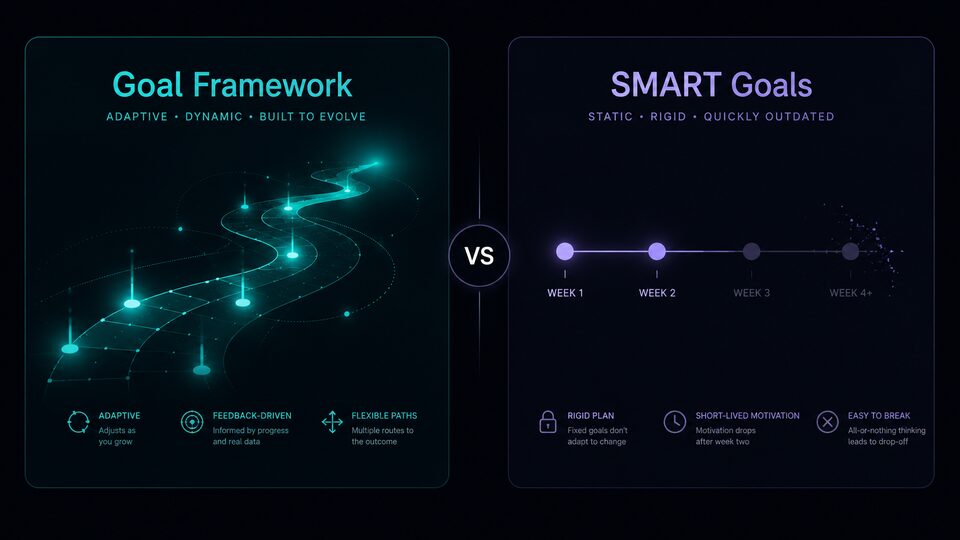
That is the difference between a static goal and a living goal framework.
FAQ
What is the best goal-setting tool in 2026?
It depends on the goal. X18 is the best fit if you want a live goal framework for one important personal mission. ClickUp and Asana are stronger for team goal management. Notion and Google Sheets are good flexible baselines. Strides is better for habits.
What is the best free goal-setting tool?
Google Docs and Google Sheets are the best free baseline because they are flexible and easy to share. The tradeoff is that you have to build the review and follow-through system yourself.
What is the best goal-setting app for personal goals?
For habit-style goals, Strides is a strong personal tracker. For bigger career or side-project goals, X18 is a better fit because it turns the goal into milestones, weekly signals, drift checks, and next actions.
What is the best tool for OKRs?
For team OKRs, look at Asana Goals, ClickUp Goals, Tability, or Weekdone. They are built around alignment, ownership, check-ins, and reporting.
Are SMART goals enough?
SMART goals are useful for writing a clearer target, but they are usually not enough for follow-through. A goal also needs milestones, weekly signals, drift checks, and a recovery plan when progress slows.
How is a goal framework different from a goal tracker?
A goal tracker records progress. A goal framework defines the operating system around the goal: mission, milestones, signals, risks, check-ins, and next actions. The tracker shows movement. The framework helps create it.
Build Your Own Goal Framework
If you already know the goal you want to move, start with the free Goal Framework Generator.
It will turn one goal into a first 90-day execution plan with milestones, weekly signals, drift checks, and next actions. If the preview is useful, you can save it as a live X18 mission so the goal has a place to keep moving.