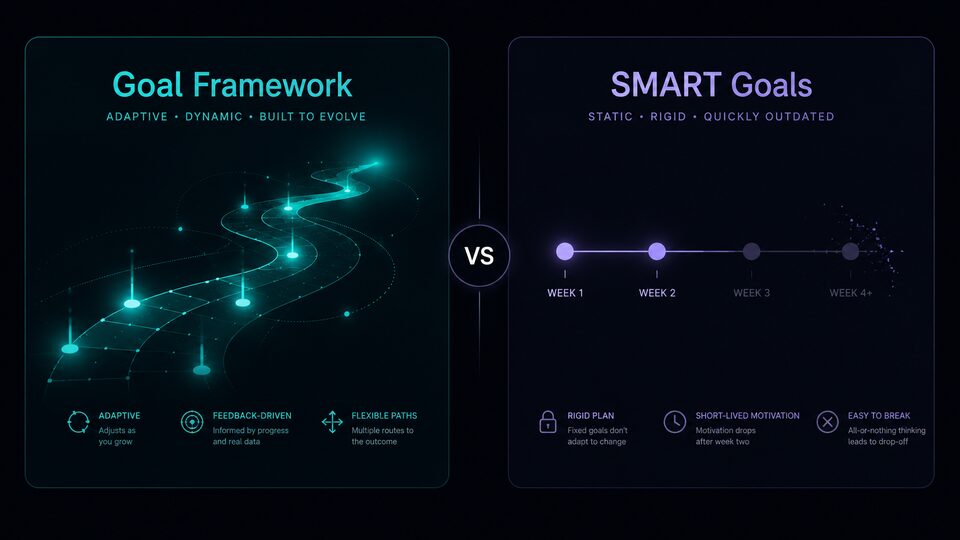

I Keep Applying for Jobs but Getting No Responses
A 90-day execution plan for turning quiet applications into a visible job-search pipeline.
Applying for jobs feels productive.
You update the resume. You scan job boards. You send applications. You keep a spreadsheet. Maybe you rewrite the cover letter again.
Then nothing happens.
No replies. No interviews. No useful feedback. Just more tabs, more roles, and the creeping feeling that the market is ignoring you.
The mistake is assuming the only answer is more applications.
Sometimes volume helps. But if the search is quiet for several weeks, the real problem is usually not effort. It is that the job search has no learning loop.
Why job searches get stuck
A stuck job search often looks busy from the outside.
But activity is not the same as momentum.
Momentum means the search is producing signals:
- target roles are getting clearer,
- the resume is improving for a specific buyer,
- outreach is creating conversations,
- applications are turning into replies,
- interviews are exposing stronger or weaker stories,
- follow-ups are happening before leads go cold.
When those signals are missing, the job search drifts into application volume.
You are doing something every week, but the system is not getting smarter.
That is goal drift in job-search form.
The mini diagnosis
If you keep applying for jobs but getting no responses, check which part of the pipeline is silent.
1. The target role is too broad
“I am looking for a better job” is not a search strategy.
It is a desire.
A stronger job search names the buyer:
- Which role titles are you targeting?
- Which company stage or industry fits your proof?
- Which problems can you credibly solve?
- Which hiring manager would immediately understand your value?
- Which roles should you stop applying to because they blur the story?
If the target is broad, every application becomes generic.
Generic applications are easy to ignore.
2. The resume is not making a sharp promise
A resume does not need to list everything you have done.
It needs to make the right person think:
This candidate has solved the kind of problem we are hiring for.
That requires positioning, not decoration.
For each target role, ask:
- What problem is this company trying to solve?
- What proof do I have that maps to that problem?
- Which bullets are only background noise?
- What metric, decision, system, or stakeholder result makes the proof credible?
If the resume could be sent to ten different roles unchanged, it may be too vague for the one role that matters.
3. There is no feedback channel
Applications alone are a weak feedback channel.
Silence tells you almost nothing.
You need signals outside the application form:
- warm intros,
- recruiter replies,
- hiring manager conversations,
- alumni or peer feedback,
- resume review from someone in the target role,
- interview debrief notes.
The goal is not networking for its own sake.
The goal is to learn why the market is or is not responding.
4. Follow-up is missing
Many job searches leak momentum after the first action.
You apply, then wait.
You message someone, then forget to follow up.
You interview, then fail to capture what changed in the story.
A search needs a weekly recovery loop:
- which leads need follow-up,
- which roles need a better version of the resume,
- which conversation created a new signal,
- which application should be retired because it teaches nothing.
Without that loop, each week restarts from zero.
A simple 90-day job-search execution plan
Use this as a first structure.
Outcome
In 90 days, build a focused job-search pipeline that produces qualified replies, useful market feedback, and interviews for roles that match your strongest proof.
Milestone 1: Narrow the target
Pick one primary job-search lane.
Write it in plain language:
- target role,
- target company type,
- strongest proof,
- problem you want to be hired to solve,
- roles you will not chase this month.
The narrowing can feel uncomfortable. That is normal.
The point is to make the search legible.
Milestone 2: Improve application quality
Create one sharp resume version for the lane.
Then test it against real roles:
- Does the first screen match the job’s main problem?
- Do the bullets show outcomes instead of duties?
- Is the strongest proof visible in the top half?
- Are you removing weaker details, not just adding more?
The weekly signal is not “applications sent.”
The weekly signal is “better-matched applications sent.”
Milestone 3: Add feedback and follow-up
For every week, define a market signal:
- one recruiter reply,
- one hiring manager or peer conversation,
- one warm intro,
- one resume critique from someone near the role,
- one interview story improved from feedback.
Then follow up on every active lead before it goes cold.
The pipeline should teach you something even before it gets you an offer.
Weekly execution loop
Run this loop once per week:
- Choose the target role lane for the week.
- Send a small batch of better-matched applications.
- Start or continue two feedback conversations.
- Follow up on every lead older than five business days.
- Update the resume, story, or target list based on what you learned.
That is the difference between “I applied to more jobs” and “my search is getting sharper.”
Turn it into a plan
If your job search keeps creating activity but no responses, do not start by downloading another resume template.
Start with the pain:
I keep applying for jobs, but getting no responses.
Then turn that into a 90-day execution system: target role, positioning, weekly market signals, follow-up checks, and next actions.
Use the 90-Day Execution Plan Generator to build a first version. After the preview is useful, save it as a live X18 mission so the search keeps moving after this week.